
Some playable games
31 Oct 2026 · Hide and Seek, Battleships.
Some experiments with ChatGPT .
I've been working with Penny (my ChatGPT) to make a couple of games. I don't really know what they're for other than for fun!
This started with me discovering Jet Lag: The Game on YouTube. They play a game in a city. It's cool, check it out. Anyway, I wanted to be able to play it with the kids, the game was out of stock, so I figured I would talk to Penny and see if we could make a version of it you could play on your phone.
Which leads me to the first game.
Tiggy Lag
So as I said just up there, I tried to buy a copy of the game that I could play with the kids while we were out and about. Unfortunately it was out of stock. I fired up Penny and we set to work.The original idea was build a playable hide-and-seek game. I wanted to base it on Jet Lag but make it suitable for public transport systems in the North West UK. Tiggy Lag was born!
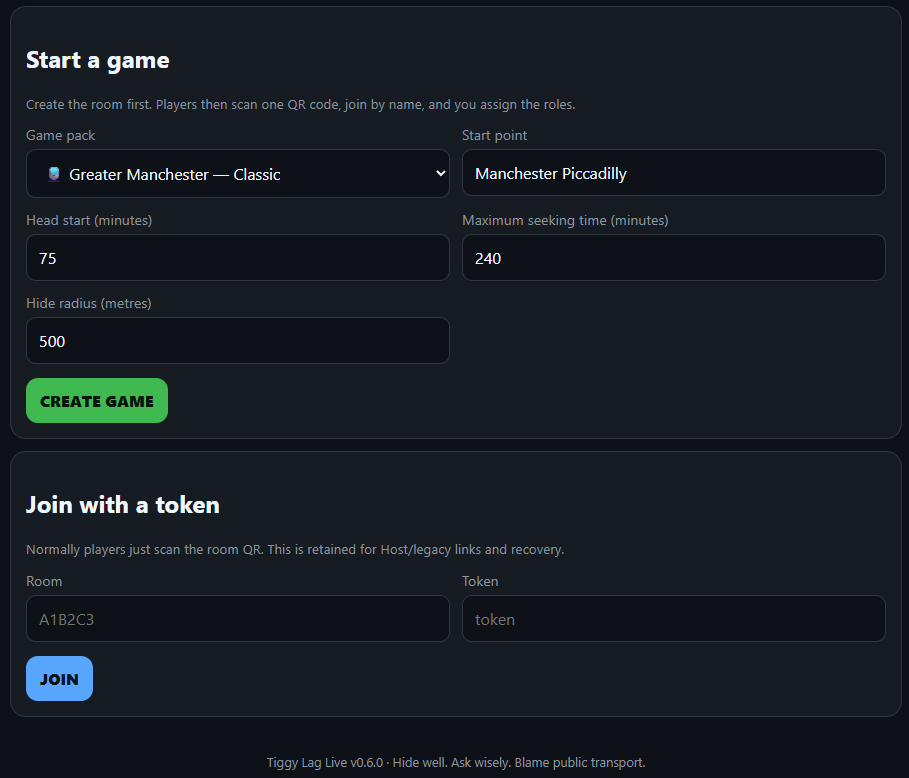
It started with a core game mechanic, one hider, one or more seekers, public transport and walking, anchor location, a 500m hide zone, a timed head start, investigation questions, chaos points and a hunt mode.
I came up with a set of virtual card set containing investigation questions, chaos cards and hunt clues. All of which are designed to help the seekers find the hider and also make it a playable game for a 9 year old (age at publishing!)
v0.1 proved that the game could work in a browser, it was just a single HTML file with rules, a timer, hider/seeker views, questions, chaos points, and hunt mode. Everything was stored locally in the browser. It proved the game mechanics and let us decide if the game was 'fun' before worrying about infrastructure!
v0.2 made it a true multiplayer game. A tiny python server allowed phones on the same WiFi network join the same game. Host, Hider & Seeker became distinct roles in the game. Game state, timers and actions were synchronised across all player devices. Hider private information was hidden from the seekers. v0.2 stopped being a browser prototype and became a (small) multiplayer game.
v0.3 moved the game to the internet. Local WiFi worked for initial testing, but broke as soon as the game moved to Greater Manchester. It went fully to the website using PHP and JSON state files. Each role received a high-entropy secret token removing the need to rely on trust in the browser. Hider only information was excluded from the seeker API responses rather than just hiding it on the screen.
v0.4 turned it into a proper mobile game. Evidence questions got photo and audio evidence captures, uploaded media is protected. Hunt clues also asked for photos. Hider can save anchor using GPS. Which unlocked GPS-assisted questions bearing, radar distance and getting warmer could all then be calculated by the sever without revealing coordinates to the seeker. Timed Chaos events were added and server-enforced events category locks, double tolls, and cancelled questions. Rounds and scoreboards were also added.
v0.5 redesigned the UI around people rather than devices. The hider phone and seeker phone were replaced with a player lobby. To play you scan a QR code and join by name, the host then assigns hider or seeker roles for each round. At the end of a round, roles can be changed. The lobby shows player status and scores. A couple of back end rules were tightened up, chaos challenges can't be marked as complete until evidence is received.
v0.6 is the current live game. It brought expansion packs for Wigan and Leigh. Each 'pack' introduces location based questions, start points and chaos cards.
Play Tiggy Lag here.
Battleships
Tiggy Lag is all well and good, but you need to be somewhere to play it. Battleships was something to keep Mitch amused while en route to somewhere.It was an experiment between chat and work modes in ChatGPT. Chat mode is like having a development partner, work mode delegates the finished output to an agent and direct it.
I gave both versions the same prompt then scored both versions on
Quality
- which looks and feels best.Functionality - are all the game rules implemented correctly?
Bugs - does it survive deliberate attempts to break it?
Autonomy - How many times did I have to intervene?
Maintainability - which code would I rather maintain?
Learning - which version gave me the most useful understanding?